Table of Contents
Apple Maps Renames Lake Ontario to ‘Lake America’: What You Need to Know?
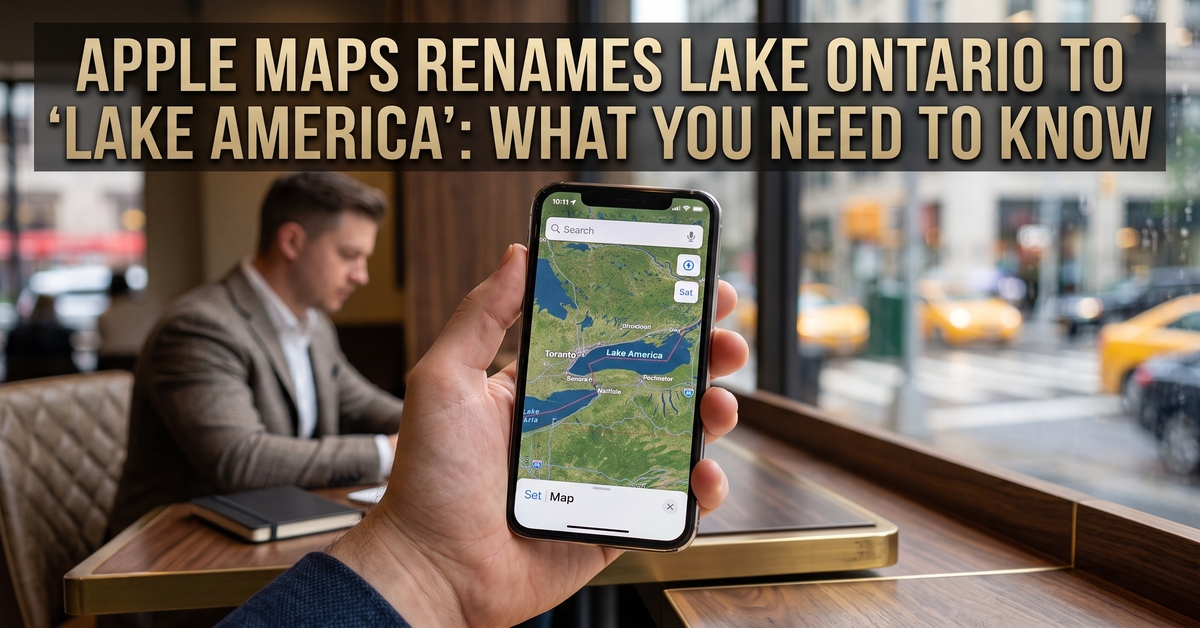
Apple Maps has made a surprising change that is attracting attention in both the United States and Canada. The mapping service is now displaying “Lake America” instead of “Lake Ontario” for users in the United States.
The change may look like a simple update to a map label, but it has a much bigger political and geographic story behind it. Lake Ontario is one of North America’s Great Lakes and sits on the border between the United States and Canada, making the naming issue particularly sensitive.
Why is Apple Maps showing “Lake America”?
The change follows the U.S. government’s decision to recognize “Lake America” as the name used by the federal government.
The move comes from President Donald Trump’s administration, which has pushed several geographic naming changes. The administration previously changed the U.S. government’s official reference to the Gulf of Mexico to the Gulf of America.
Apple Maps’ latest update follows that broader policy.
For people opening Apple Maps in the United States, the lake can now appear under the name “Lake America.” However, that does not mean every person around the world will suddenly see the same name.
What will Canadian users see?
This is where the situation becomes particularly intriguing.
Lake Ontario is shared by the United States and Canada. It borders the Canadian province of Ontario and the U.S. states of New York.
Canadian users continue to use the traditional name Lake Ontario. The name is deeply established in Canadian geography, government, tourism, education, and everyday conversation.
As a result, the same body of water can appear under different names depending on where a person is viewing the map.
For U.S. users, Apple Maps displays “Lake America,” while Canadian users continue to see “Lake Ontario.” People in other parts of the world may see both names depending on the mapping service and regional settings.
Has Lake Ontario officially disappeared?
No.
The physical lake has obviously not changed, and the traditional name has not suddenly disappeared from international use.
This is primarily a geographic naming and mapping issue.
Place names can sometimes vary between countries. Governments may use different official names for the same geographic feature, while international organizations, local communities, and mapping companies may continue using another name.
That is essentially what is happening here.
For Americans using Apple Maps, “Lake America” is now the prominent label. In Canada, however, “Lake Ontario” remains the familiar name.
Why does the change matter?
The timing is one reason the update has generated so much attention.
Lake Ontario is not an isolated American landmark. It is a shared Great Lake connected to both countries, and its name has been used for generations.
That makes the decision more politically sensitive than changing the name of a geographic feature located entirely within the United States.
The move also highlights how technology companies can become involved in political and cultural debates simply by deciding which official geographic names to display.
A map application may appear neutral, but its labels can influence what millions of people see and recognize.
Apple Maps is not the only mapping service facing the issue.
Apple’s decision also raises questions about how other mapping platforms will handle the naming dispute.
Different companies can make different choices about geographic labels, particularly when governments, local authorities, and international conventions do not agree.
That means users could potentially see different names for the same lake depending on which mapping application they use and which country they are accessing it from.
This isn’t necessarily a technical error. It can be the result of regional naming policies and different geographic databases.
What does Canada think?
The Canadian position remains tied to the traditional name, Lake Ontario.
The lake is strongly associated with Ontario, Canada’s most populous province, as well as major Canadian communities along its shoreline.
The naming dispute therefore goes beyond a simple software update. It touches on the long-standing relationship between the United States and Canada and comes at a time when relations between the two countries have faced political and economic tensions.
For many Canadians, changing the name of a shared lake is likely to be viewed as an American political decision rather than a universally accepted geographic change.
What should Apple Maps users know?
If you open Apple Maps in the United States and see “Lake America,” there is no reason to think you are looking at a different lake.
It is still the same Great Lake traditionally known as Lake Ontario.
The key difference is the label being displayed to users in different regions.
Whether “Lake America” becomes widely accepted outside the United States remains uncertain. Geographic names can take years, or even decades, to become established internationally.
For now, the safest way to understand the situation is simple: U.S. users may see Lake America, while Canadians continue to call it Lake Ontario.
In Conclusion
Apple Maps’ decision to display “Lake America” for U.S. users is another example of how political decisions can quickly make their way into everyday technology.
The lake itself has not changed, and Lake Ontario remains a widely recognized name. What has changed is the label that Apple Maps presents to users in the United States.
As other mapping companies decide how to handle the issue, the naming dispute could continue to attract attention—particularly because the lake is shared by two countries with a long and closely connected history.
Explore More: Apple Watch 11 Tips: Explore Hidden Tricks, Smart Gestures, Health Features, and Secret Settings Every User Should Know